Grow Your Business Alongside a 9-5 Without Giving Up Your Weekends

If you prefer to listen to the blog post, you can do that here 👆
You are juggling a demanding career while building your own business, and you want a structure that allows you to make real progress on your goals and still have energy left over for yourself at the end of the day.
If you have found yourself sitting at your kitchen table on a Sunday afternoon, feeling equal parts exhausted and guilty because you haven't crossed off everything on your to-do list... take a deep breath.
There is nothing wrong with your work ethic, your discipline, or your commitment to your business vision.
What is actually happening is that you have been handed a broken model for growth. We have been conditioned by traditional productivity advice to believe that building something of our own requires an endless season of relentless hustle where personal time, rest, and weekends off simply have to be sacrificed for the greater good. We tell ourselves that this is just a temporary phase every ambitious entrepreneur must face until the business reaches a certain milestone.
However, when you spend five full days giving your prime mental energy, creativity, and focus to a career, rolling straight into a twelve-hour weekend work marathon leaves your nervous system completely drained. Instead of recovering from the workweek, you are layering cognitive fatigue on top of existing physical fatigue. You end up starting Monday morning already in a severe energy deficit, which bleeds directly into your focus at work, your mood at home, and eventually your physical health.
When your side business relies entirely on sacrificing your days off, every milestone you reach comes at the direct cost of your well-being. Building real, sustainable momentum in your business does not require giving up your weekends. It requires shifting how you protect, manage, and structure your energy.
In this post, I am breaking down a practical way to manage your time and energy so you can grow your business alongside your 9-5 without giving up your weekends.

The Hidden Psychology of the Weekend Sprint Trap
Before we look at how to restructure your week, we need to examine why the weekend sprint feels like the only option in the first place.
Most women juggling a career and a business fall into a predictable pattern. During the workweek, your energy is continuously drawn upon by meetings, deadlines, unexpected fires, complex decision-making, and workplace demands. By the time 5 PM arrives, your brain has reached its limit for cognitive processing. You look at your business to-do list, feel overwhelmed, and promise yourself that you will make up for lost time on Saturday and Sunday.
This sets up an unrealistic expectation for the weekend. You expect yourself to shift seamlessly from a week of high-pressure corporate execution into a weekend of brilliant, highly creative strategic execution for your business.
When Saturday morning arrives, your body naturally tries to slow down and recover from the accumulated stress of the workweek. But instead of honoring that physiological signal, you force yourself to open the laptop. Because you have given yourself all day to work, the work naturally expands to fill every available hour. Tasks that should take thirty minutes end up stretching into two hours of semi-focused effort interrupted by distraction and procrastination.
By Sunday evening, you are left with a double penalty. You did not get the rest your body needed to reset, and yet you still feel like you did not get enough done in your business to justify the sacrifice. This creates an ongoing cycle of guilt, decision fatigue, and physical exhaustion.
Breaking this cycle requires stepping away from traditional time-management advice and adopting a structure built around human energy cycles.
The Root Cause: Understanding Transition Fatigue
One of the biggest reasons high achievers struggle to work on their business during the week is not a lack of time. It is transition fatigue.
Moving from your primary job into your own business requires a complete shift in mindset, identity, and cognitive processing. At your job, you are operating within an established framework, fulfilling specific roles, and often responding to external demands. In your own business, you are the visionary, the manager, and the executor all at once.
When you try to jump straight from a full day of employment into working on your business at 6 PM, your brain experiences severe context-switching friction. You are asking a tired brain to suddenly switch from reactive processing to proactive strategic creation without a buffer zone.
Recognizing this friction is crucial. When you realize that your evening fatigue is a predictable biological response to context switching rather than a personal failure, you can stop fighting your body and start designing a routine that works with your natural physiology.
1. Eliminate Decision Fatigue Before You Start

When you finish a full day at your job, your brain has already made hundreds of choices. Asking yourself at 6:00 PM what you should work on next drains whatever focus you have left.
When your focus is low, you default to easy, low-impact tasks like organizing folders, tweaking website styling, or scrolling for ideas. These activities feel productive in the moment, but they do not move your business forward. They simply consume the rest of your evening while keeping your business in the exact same spot.
To preserve your energy, I recommend separating planning from execution, meaning not deciding what to do and actually doing the work at the same time.
The Decision Trap
The Frictionless Transition
High Leverage Actions That Build Momentum
Draft direct audience communications: Instead of staring at a blank page, write a clear message or post addressing one specific problem your ideal client experiences, ending with a simple way for them to reach out to you.
Outline your core service framework: Map out the exact steps a client takes when working with you, defining what happens from the initial conversation to the final result.
Set up a simple client contact method: Make sure potential clients have a straightforward way to reach you or book a conversation, making it as easy as possible for them to reach out.
So to follow my own advice, you can book a free call with me by tapping the button below if you're tired of guessing what to do next and want a straightforward way to organize your work.

Now let´s move on to talking about the frictionless system:
The pre-decision rule: Before you end your week, write down the exact action steps for your upcoming weekday work blocks. Make the tasks so specific that you can execute them without having to think.
Prepare your physical and digital space: Before starting your evening session, open the exact document, sheet, or tool you need. When your work time begins, your screen is already set to the single task, eliminating all startup friction.
2. Work in Short Focused Windows Instead of Weekend Marathons
Saving all your business tasks for Saturday creates a false sense of security. When you think you have an entire afternoon ahead of you, tasks naturally stretch to fill the time. A simple task takes four hours, perfectionism takes over, and your entire weekend disappears.
Relying on weekend sprints also deprives you of the deep rest required to function well during the week. You end up entering Monday morning already tired.
Working in short, effective blocks during the week creates natural urgency and keeps your momentum steady.
A single focused 60-minute window on a Tuesday night gives far better results than six unstructured hours on a Sunday. Short windows force you to ignore unnecessary details, avoid overthinking, and finish what you started.
Most importantly, keeping your weekends clear allows your nervous system to fully reset, so you show up to the new week with energy and motivation.
Saturday: 8 Hours
Unfocused time leads to overthinking, task expansion, and burnout.
Tue / Thu: 60 Mins
High focus drives immediate action, progress, and leaves weekends completely free.
High Leverage Actions That Build Momentum
Create a simple, helpful resource: A brief guide or checklist that offers immediate, practical value to the people you aim to help.
Streamline client communication: Write clear templates for common client questions or inquiries, allowing you to respond thoughtfully in a fraction of the time.
Connect with aligned peers: Reach out to individuals or partners in related fields to build genuine relationships and foster future collaboration.
The Frictionless System
Set a defined work container: Use a timer set for 45 to 60 minutes. Work on your chosen task until the timer sounds, then stop regardless of whether it feels perfect.
Protect the weekend boundary: Declare Saturday and Sunday as completely off limits for routine business tasks. Knowing your weekends are protected encourages true focus during your weekday blocks.
3. Create a Weekly To-Do List With Broken Down Tasks
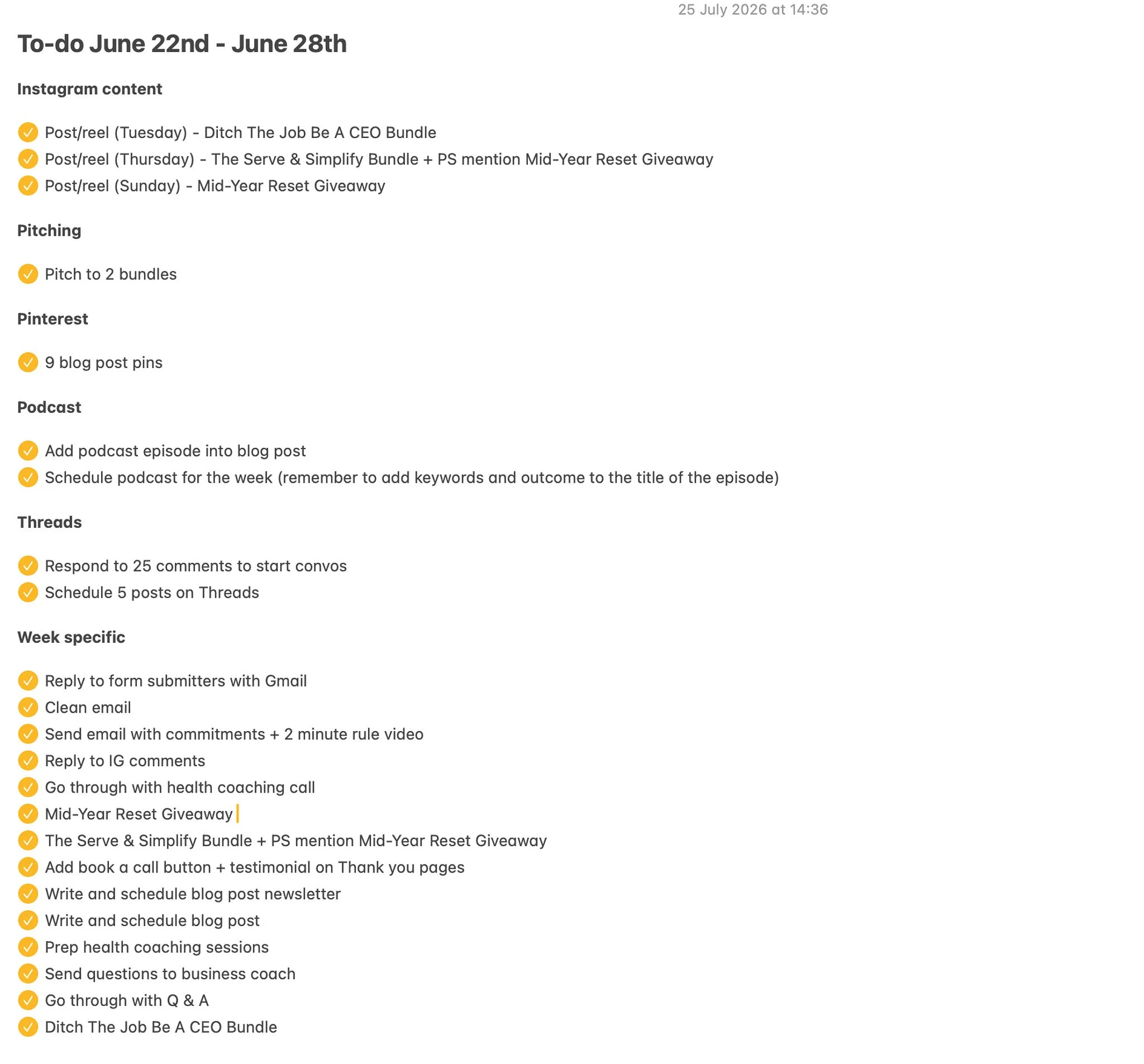
Working from a massive, unstructured to-do list keeps your brain in continuous overdrive. Jumping between different types of thinking in a single evening causes cognitive friction. You finish the evening feeling done, yet very little actually gets finished.
Instead of trying to tackle everything at once, break down your tasks into manageable steps that you can check off when they´re done. If you wanna take it a step further, assign one specific focus to your dedicated work nights. Grouping similar tasks together keeps your brain in a single mindset, allowing you to work faster and with much greater ease.
High Leverage Actions That Build Momentum
Focus Area: Content & Audience Connection
Draft a newsletter or post that answers a common question your audience asks.
Connect with your audience through short, encouraging messages that share practical insights and invite conversation.
Focus Area: Services & Client Experience
Refine your onboarding process so new clients feel fully supported from the moment they sign up.
Organize your core materials or session notes so everything is accessible in one place.
Focus Area: Administration & Simple Systems
Set up an automated booking link to make scheduling calls simple and back-and-forth-free.
Update basic administrative documents and payment details to keep your business running smoothly.
4. Set a Firm Evening Shutdown Ritual

When you build a business alongside a job, it is easy to feel like you should always be working. Without a clear stopping point, business thoughts drift into your personal life, family time, and evening relaxation.
If you are thinking about your work constantly, you are never actually off. This continuous mental strain wears down your energy, impacts your sleep quality, and eventually leads to burnout.
To give yourself true permission to relax, establish a firm shutdown ritual at the end of every work window.
High Leverage Actions That Build Momentum
Document simple routines: Write down clear, step-by-step notes for recurring tasks so you can complete them quickly in future sessions without extra mental effort.
Keep a centralized workspace: Store everything in one digital location to eliminate late-night searches for misplaced information.
The Frictionless System
Establish a hard-out time: Pick a specific time (e.g., 8:30 PM) when all work stops. When the time arrives, step away regardless of what remains on your list.
The 5-minute closeout: Spend the last five minutes of your session noting what you completed, writing down the exact starting task for your next session, and closing all open tabs.
Create a physical reset: Close your laptop, put your workspace materials out of sight, and move into your evening activities. This physical action signals clearly to your mind that the workday is officially complete.
Rest Is Essential for Sustained Growth

Building a business while working a 9-to-5 does not require sacrificing your health, working late into the night, or giving up your weekends.
Real momentum comes from doing high-leverage work in short, consistent blocks during the week, leaving your weekends completely open to recharge, enjoy your personal life, and return to your week feeling refreshed and clear.
When you learn to manage your focus and set intentional boundaries around your time, you can make meaningful progress on your business and still have plenty of room to unwind, relax, and enjoy your weekends.
Want Help Creating a Sustainable Weekly Schedule?
If you want to stop feeling overwhelmed and instead get a clear, practical way to manage your time and energy, let us connect.
Tap the button below to book a free call so we can map out a sustainable routine that fits your life.