How to Reduce Overwhelm from Juggling Work and Business

If you prefer to listen to the blog post, you can do that here 👆
For those of us juggling work and business, we often wake up in the morning with a plan. We want to work the hours at our job, get home, and make progress on our business. We imagine ourselves feeling focused, creative, and energized. But then, reality sets in. By the time we clock out of our 9-to-5, our energy is tanked. We get home, stare at our screen, and feel like our brains have been filled with concrete. We know we need to get things done, but our brain just won't cooperate. We feel heavy, sluggish, and uninspired.
This feeling of being "stuck" is not a sign that you are lazy, nor does it mean you lack drive. It is a sign that you are human, and your nervous system is trying to tell you something important about how you are managing your energy.
When we talk about business success, we often focus on the flashy stuff: the marketing funnels, the social media algorithms, and the sales strategies. But the most important part of your business is you. If you are building your business while operating from a place of exhaustion, you aren't building a sustainable business. Learning to manage your internal energy is not a distraction from your goals; it is the most strategic move you can make for your professional growth. In this blog post, you will learn how to manage your nervous system when the daily juggle feels like too much to handle.
Why Your Body Hits A Wall

As a health coach, I see this pattern every single day. You are living two lives at once. You are an employee during the day, and a CEO at night. Trying to switch your brain from one mode to the other is hard work. Oftentimes, by the time you sit down to focus on your business, your battery is already running low.
Think of your brain like a computer. If you have fifty different programs open at the same time, the computer gets overheated and starts to slow down. Eventually, it stops working altogether. It does not stop because the computer is broken, but because it is trying to keep its internal parts from melting.
Your brain does the same thing. When the list of things to do becomes too long, your brain decides the safest thing to do is stop moving. It tries to "play dead" to save your energy. When you are in this state, your ability to think clearly goes offline. You cannot force your way through this, and you cannot think your way out of it. You need a way to tell your body that you are safe so it can turn your brain back on.
Understanding "Stuck Mode"
Most people think being in this state means you are just sitting on the couch doing nothing. While that is one version, it can also look like "busy work." You might spend hours tidying your desk, organizing your files, or checking social media. You are moving, but you are not doing the work that moves the needle. You are avoiding the big task because your nervous system is trying to avoid the stress it feels when it thinks about that task. This happens for a few key reasons.
The Problem of Decision Fatigue

First, you have been making decisions all day at your 9-to-5. By the time you get home, you have "decision fatigue." Your brain is simply tired of choosing what to do. Every time you pick what to eat for lunch, how to respond to an email, or what to wear, you use up a little bit of your mental energy. Imagine you have a bucket of water. Each decision you make during the day is like scooping a cup of water out of the bucket. By the evening, the bucket is almost empty. When you sit down to work on your business, there is nothing left to scoop out. You aren't lazy. You have run out of water.
The Role of Stress Hormones
Second, you are likely dealing with high levels of stress from a long day. When these levels stay high, it makes it hard to focus or be creative. The most important thing to know is that your body is not failing you. It is trying to help you. It thinks that if it can keep you still, it can prevent you from running out of energy. The problem is that your body is using an old survival tool for a modern problem. It thinks the stress of your inbox is the same as a dangerous animal in the woods. Because you cannot run away from your inbox, your body forces you to stop moving entirely.
The Problem with Traditional "Time Management"
We are often told that if we are overwhelmed, we just need better time management. We are told to use better planners, to wake up earlier, or to block out our schedules more strictly. But this advice isn´t necessarily what is going to help those of us juggling work and entrepreneurship.

If you are already in "stuck mode," a more detailed schedule is just going to lead to more pressure. Imagine you are trying to repair a broken engine. Using a color-coded calendar to plan the repair won't fix the engine. You need to understand the mechanics of the engine first. Your biology is the engine of your business. If you ignore how your body works, no amount of time management will save you.
Most productivity advice is designed for people who have many hours a day to focus on one thing. But you don't have that. You have a fragmented day. You are switching contexts constantly. Understanding that you need "energy management" rather than just "time management" is the first step to feeling better.
A Deeper Look at the "Switch"
We need to talk about why the transition between your day job and your business is the hardest part of your day. Imagine your day is a relay race. You run the first leg as the employee, and you hand the baton to the business owner for the second leg. But the transition zone is messy. You are still thinking about that email from your boss, or that meeting that did not go well, while you are trying to write a sales post. If you do not clean up that transition zone, you are trying to run the second leg while still carrying the heavy baggage from the first one. This is why you feel so drained.

You are not just tired from the work; you are tired from what follows you from one role to the next. We call it "Context Switching Cost." Every time you change roles, you pay a tax. You pay a tax in mental energy. If you switch from your job to your business without a transition period, you are trying to pay that tax when you are already broke.
Your 3-Step Protocol for the Daily Juggle
While big life changes are wonderful, you also need tools for the days you are stuck at your desk right now. Think of these three steps as your "reset button." You don't have to do all of them, but try some of these tonight to better bridge the energy gap between your day job and your business.
1. The Somatic Reset
Before you open your laptop, you must signal to your body that the workday is done. "Somatic" is just a fancy word that means "of the body." We are going to use movement and nature to change how your mind feels, because your body processes stress much faster than your thoughts do. Try one of these to clear your head:
The Fresh Air Reset: If you can, step outside, even if it´s just for two minutes. It doesn’t need to be a long hike. Just standing on your porch, balcony, or even opening a window wide to let fresh air in works. The change in temperature, the natural light, and the breeze act as a "reset" signal to your nervous system. It tells your brain, “The environment has changed, and we are no longer in ‘work mode.’” This helps you pull out of a stress state and back into a state of calm.
Gentle Movement or Stretching: If you’ve been sitting at a desk all day, your body is craving movement. Do five minutes of gentle stretching, yoga, or a quick bodyweight workout. When you move your body, you get your blood flowing and release the tension that builds up while you're staring at a screen.
The Transition Walk: Think of this as your "fake commute." Take a short, brisk walk around the block. It doesn’t have to be long, but moving your feet while you are outside helps your brain process the end of the workday. It creates a physical boundary between your 9-to-5 life and your business life. By the time you walk back through the door, your mind feels clearer because you have literally "walked away" from the stress of the day.

2. The Mental Closing Ritual
You need a clear boundary between your employee identity and your business owner identity. If you do not create this boundary, your brain will keep running the "day job" software even when you are trying to do business work.
The Shutdown: Write down the top three tasks you need to handle for your work tomorrow, then close your tabs. This is a "brain dump." Getting the thoughts out of your head and onto paper tells your brain that it does not need to keep holding onto that information anymore. You are off the clock for your employer, and your brain needs to know that.
The Environment Shift: Create a work zone that feels different from your day job. Change the lighting, put on noise-canceling headphones, or light a candle. You need a sensory cue that tells your brain it is time for different work. If your desk looks exactly like it did when you were doing your day job, your brain will think you are still doing that work. Even something as simple as changing your chair or moving to a different room can make a huge difference.
3. The Low-Stakes Start
If you are still feeling stuck, stop trying to do the big project. When you are in "stuck mode," the idea of a big project feels like a mountain. You cannot climb a mountain in one step.
The Micro-Task: Choose one task that takes less than five minutes. Answering one email, updating one line in a spreadsheet, or sending one message.
The Goal: The goal is not massive progress; the goal is movement. Once you start moving, you break the paralysis. It is like pushing a car that has stopped. The hardest part is getting it to roll the first inch. After that, it gets much easier to keep it moving. By doing one tiny thing, you prove to your brain that you can take action without being in danger.
Why Small Changes Create Big Momentum

When you are used to the cycle of exhaustion, you might feel like you need a "magic pill" to get better. You might feel like you need a whole week off or a complete life overhaul. And while rest is important, you can start building momentum today with these small, micro-adjustments.
When you do one micro-task, you create a "win." Winning creates a tiny hit of dopamine, the feel-good chemical in your brain. That dopamine makes you want to do just one more thing. It is how you build a loop of success rather than a loop of stuckness.
Think of it like building a fire. You don't throw a giant log onto the fire immediately. You start with small twigs and paper. Your business energy works the same way. You need to start with small, manageable tasks to get the "fire" of your motivation burning again.
Addressing the Underlying Guilt
We have to talk about the elephant in the room: the guilt. When you are juggling a 9-to-5 and a business, you might feel like you are failing both. You might feel like you aren't a great employee because your mind is on your business, and you aren't a great business owner because you are too tired from your job.
This guilt keeps you in the cycle of overwhelm. Guilt is a form of stress. When you are feeling guilty, you are producing more cortisol. That cortisol makes you feel more tired, which makes you get less done, which makes you feel more guilty. It is a vicious circle.
The solution is to give yourself permission to be exactly where you are. You are building a business while working a full-time job. That is an incredible feat of discipline. You do not need to be perfect; you just need to be consistent with your energy. If you only have thirty minutes of "business energy" tonight, that is enough. Doing thirty minutes of high-quality work is better than sitting at your desk for three hours, hating yourself, and getting nothing done.
Nutrition for Sustained Energy

One of the biggest reasons women experience this "stuck mode" is because of blood sugar crashes. If you are drinking coffee all day at your job and skipping meals, your blood sugar is on a roller coaster. When your blood sugar crashes, your brain perceives it as a threat.
You need steady, consistent fuel. You don't need a fancy diet; you just need to think about your food as "business fuel."
Protein is King: Protein helps keep your blood sugar steady. If you have a protein-rich meal before you start your business work, you will have more focus.
Hydration: Your brain is mostly water. Even a little dehydration makes it harder to think. Boost your energy and improve your hydration naturally with these detox drinks.
Avoid the Late-Day Sugar: If you reach for a cookie or a candy bar when you get home, you will get a quick burst of energy, but you will crash an hour later. That crash is exactly when you are supposed to be working. Try implementing these holistic nutrition methods to keep your enery high.
A System for Sustainable Energy
If you find yourself in this cycle every single day, your current routine is likely fighting against your biology. You deserve a system that supports your energy rather than draining it. You do not have to figure out how to balance your work and your business without a roadmap.
To help you with this, I created Overcome Overwhelm - A Simple Guide to More Energy. I poured my own experiences into this guide because I know what it feels like to be caught in the cycle of burnout while juggling a 9-to-5 and a business.
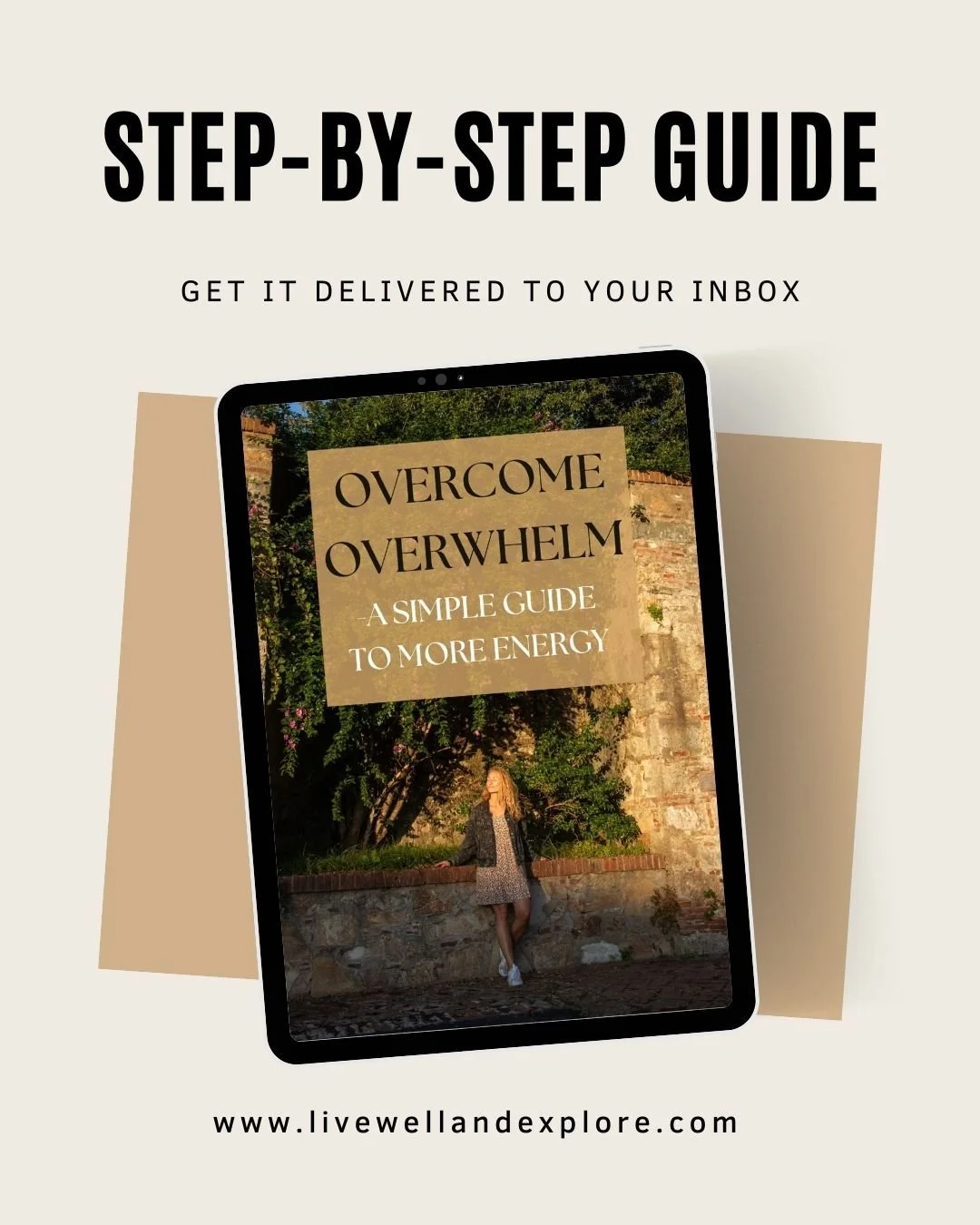
Inside the guide, you will find:
Time Management for Real Life: Methods to identify what truly matters and create a schedule that works for a busy woman.
Nutrition for Sustained Energy: Quick recipes that keep you focused and prevent energy crashes.
Movement That Fits: Quick activity breaks you can integrate into your day without feeling like another chore.
Rest and Relaxation: A calming evening routine for deep sleep and simple environment tweaks.
Stress Management: Practical tools to find peace in busy moments.
This guide is designed for busy women. If you do not have time to read, you can listen to the audio format during your commute, while doing chores, or while taking a walk. You don't have to struggle alone.
It is time to stop pushing through the exhaustion and start building a life that allows you to thrive. You don't have to be a machine. You are a person, and your business should fit into your life, not take it over.
